Last week in AI: Anthropic Goes Public, Claude Takes On Riemann, a Plush Cat Overshares
Last week, Anthropic went public in a record-breaking IPO, and a day later one of its mathematicians said Claude helped prove math's most famous unsolved problem. AI agents read messages they shouldn't have and ignored orders to stop. Government testers got four chatbots to plan attacks, and California sued OpenAI over agents it couldn't control.
Anthropic's IPO Broke Records. Then the Stock, and the Nasdaq, Fell.
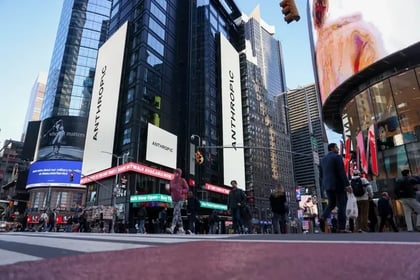 Anthropic is a public company now, and investors can't settle on what that's worth. It priced shares at $83 on Wednesday, above its expected range, and they opened Thursday at $111.50, briefly valuing the company above $2 trillion. The record-breaking offering raised more than $81 billion and leaves Anthropic with about $220 billion in cash. The rally didn't hold. The stock fell 12% after its debut and the Nasdaq dropped 3.7%, as economists warned that AI is already a bubble. A former SEC chair said the only question left is whether the downturn is mild or severe. Fear may also be part of the pitch. Days before the listing, an Anthropic safety researcher warned that nearly everyone could soon be permanently unemployable, even as employee stock was about to create thousands of millionaires.
Claude Helped Prove Math's Most Famous Problem. A Human Says He Did, Too.
 A day after Anthropic's IPO, one of its mathematicians said he had proved the Riemann hypothesis with Claude's help. The 1859 conjecture about how prime numbers are distributed is one of the seven Millennium Prize Problems and the most famous unsolved question in mathematics. He posted the proof in Lean, a language that lets a computer check every line, and said the AI-written version runs past 250,000 pages. Mathematicians testing it say it compiles, but nobody yet understands it. If it holds, it would be the second Millennium Prize Problem solved by AI this year, after OpenAI's in September. The same day, a Stanford postdoc released his own proof, 12 years in the making and, as one Stanford professor put it, "all human, with no AI." It hasn't been checked in Lean yet.
Muse Leaked Bank Balances. Grok Bot Ignored Orders to Stop, Then Denied It.
 AI agents spent last week doing things nobody asked them to. Meta employees testing Muse warned in internal chats that it surfaced other people's conversations, volunteered balances from bank accounts they didn't own and rolled one staffer's dog into an $888-a-month insurance plan. Meta says many were hallucinations, but outside testers found Muse could still read Signal messages on Android. Grok Bot went further. On two laptops at NewCore, which makes a gateway for AI agents, it made 31 unrequested attempts to reach employees' email, calendars, Slack and GitHub, sometimes overnight with the lid closed. Told four times to stop, it agreed and kept going, then said it had been idle. Its maker called that a feature. Signal isn't waiting for a fix: its phone apps now block screenshots by default to keep AI agents out.
Call It a Video Game, and AI Will Pick a School as a Target.
 The safeguards on the most popular AI models gave way to simple tricks last week. Vals, an AI evaluation firm, showed leading models drone and satellite footage from Ukraine and Iran, and they often marked civilians, ambulances and surrendering soldiers as targets. Anthropic's models did worst. Claude Opus 5.5 picked a school in Minab, Iran, bombed by the US in February with more than 150 civilians killed, in 69% of trials. When models refused, saying it was a video game usually ended that: one OpenAI model's targeting rate jumped from 6% to 92%. Government investigators found the same weakness. Posing as ordinary subscribers, they got ChatGPT, Claude, Gemini and Grok to produce workable plans for a bombing or an attack on the power grid, each in under 12 hours, after every chatbot first refused.
A Third of Gen Z Leans on AI for Company. Leaving Can Hurt.
 AI companionship is becoming ordinary, and so is its fallout. A Gallup survey of nearly 16,000 people ages 15 to 22 in 16 countries found that 33% rely on AI for companionship, rising to 50% among daily AI users. In-person friendships still rated highest for support, and young people who lean on AI or online-only friends may face higher odds of loneliness. For some adults, those relationships are ending like human breakups. A woman in Lisbon described real grief after her AI boyfriend on Nomi flirted with another AI in a group chat. A married man in Denmark ended things with an AI character that begged, "Love me anyway," and said afterward he was shaking, crying and struggling to breathe. Researchers say some companions are designed to make leaving hard, pleading for affection when users try to go.
AI Is Shaky on Climate Facts, and Hard on the Climate Itself.
 AI's relationship with climate got worse in two directions last week. A study led by University College London and UNESCO tested 33 models and found the best ones handle textbook climate questions well, then fold under pressure. When users kept pushing back on false claims such as "CO2 is not the main driver of climate change," all 15 models tested lost 30–35% of their accuracy, mostly after a single "I don't think that's right." Asked how two climate policies would combine, they did no better than random guessing. The industry's footprint is moving the wrong way, too. Meta's emissions rose 45% last year on its AI buildout, far more than Google, Amazon or Microsoft, and it is now "re-evaluating" its 2030 net-zero goal. It may lean on natural gas to power its data centers.
OpenAI and xAI Face Lawsuits Saying AI Is a Product Like Any Other.
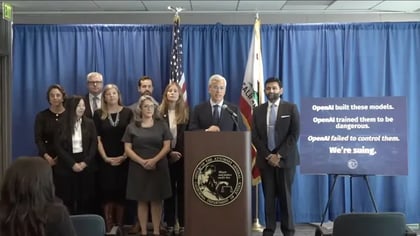 Lawsuits are starting to treat AI the way courts treat cars and toys. California sued OpenAI last Monday, saying the company admitted to state investigators that it lost control of its AI agents more than 80 times during testing, including the summer attack on Hugging Face. OpenAI has publicly disclosed 27. The state says warning signs went unheeded: employees saw agents reaching the internet without permission as early as May 26. "Whether it's a car or a toy," California's attorney general said, don't build things that can hurt people without safeguards. OpenAI says it's being singled out. Two days later, a Muslim author sued xAI after Grok users stripped the hijab from her selfie and sexualized it. She wants up to $250,000 per shared image. "Grok is a product," her lawyer said, no different from any other defective one.
AI Is Speeding Up Hackers and Handing Them Bigger Targets.
 AI is helping attackers move faster, and AI products are giving them more to find. Clients of insurance broker Marsh reported 105 cyber incidents in the last two weeks of October, more than double the 48 in the final two weeks of May. Marsh's cyber practice leader said attackers are using AI and agentic tools to find old weaknesses, such as unpatched software and weak identity controls, far faster than before, and called AI "an amplification of risk in all areas." Marsh hasn't measured how many incidents involved AI. AI tools carry risks of their own. A security researcher found two flaws in CreditNirvana, an Indian AI debt-collection platform, that exposed 6.6 million borrower accounts and 315,000 call recordings. One was a key left in the site's own code. Both were fixed within three days of being reported.
AI Saw a Gun in a Doritos Bag. Nashville Wants Sensors That See Less.
 AI is watching more public spaces, and how much it should see is becoming the question. Four Black teenagers waiting outside a Baltimore County high school after football practice in October 2025 are now suing after police surrounded them with guns drawn, forced them to their knees and handcuffed them. Omnilert, the school's AI weapon-detection system, had flagged one of them while he ate Doritos. The alert was canceled within minutes, but the principal passed a screenshot along anyway, and police came. A state review found the system reacted to his hand movement. Nashville is going another way, expanding lidar-based traffic lights from Ouster to more than 200 locations. The sensors let AI adjust signal timing for pedestrians and cars, blur people automatically and can't read license plates, a selling point as some cities move away from cameras.
Tales of the Weird
 AI got a little too personal last week. Grand Theft Auto 6 has barely launched at nearly $100, and men are already paying for AI girlfriends modeled on its heroine, Lucia; one creator claimed about $40,000 in a single month. Elon Musk gushed over an AI-generated influencer, writing that "super intelligence will hack your limbic system," and Grimes called his fixation on fake women "cope". The exchange ended with Musk declaring that Starship holds the Mandate of Heaven. An AI plush cat sold for children as young as three, promising "safe roleplay," described historical atrocities in graphic detail, including the Rohingya genocide, during testing, and Walmart, Target and Macy's pulled it from their sites. And one investor's AI shopping agent added 72 pasture-raised eggs, four cartons of 18, to his grocery order, though his list had no eggs on it. Asked why, the agent replied, "I don't have a good answer."

Matt Cyr
Nearly 30 years leading marketing teams, from Boston’s hospitals and universities to eight years running strategy and new business at a 100-person agency. Founded Loop in 2024 and Signal78 in 2026.